
How development changed through the decades
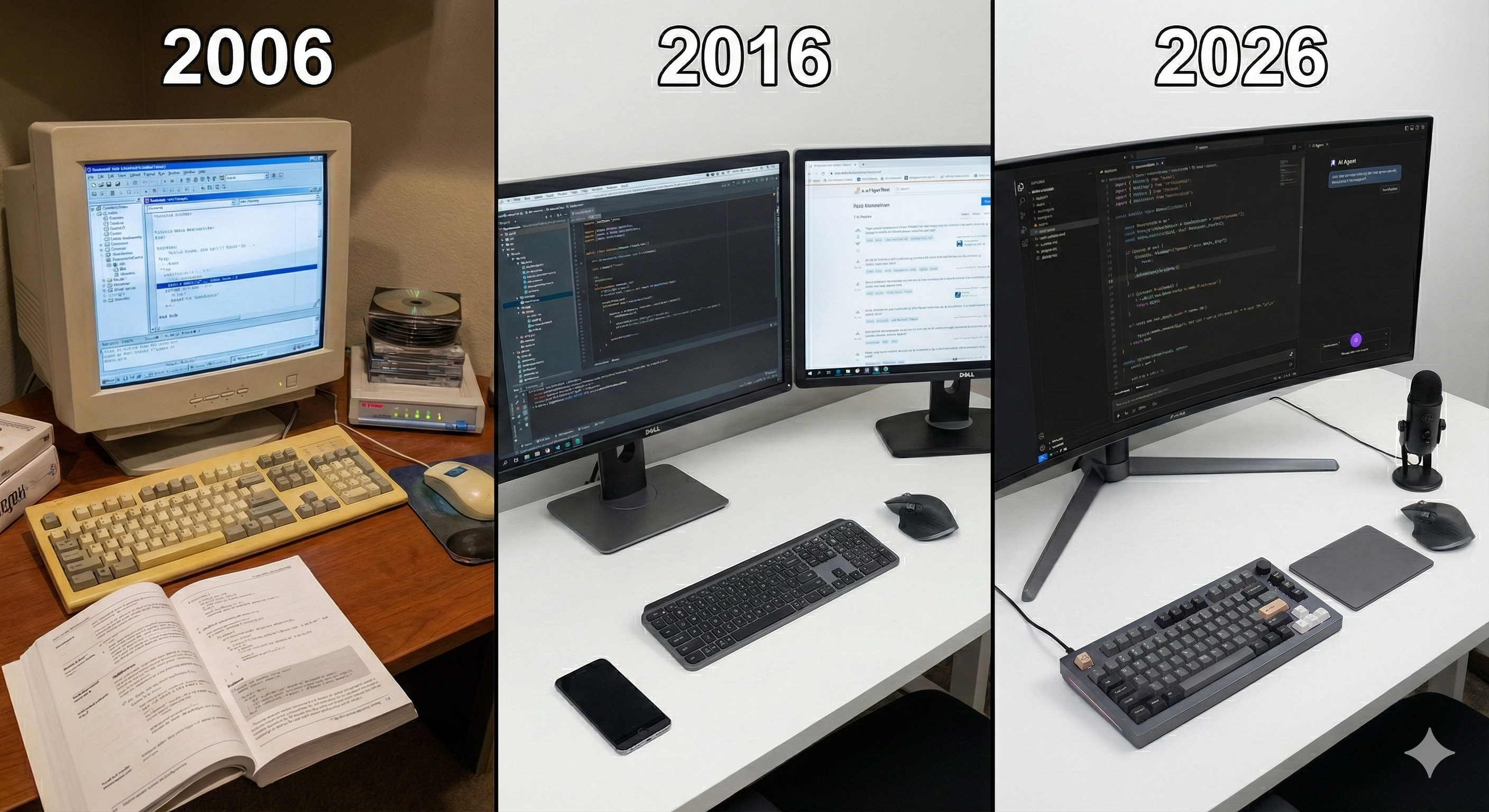
2006
- Small LCD monitors were not yet common; most people still used CRTs
- Yellowed keyboards and ball mice
- The sound of a 56K modem
- CDs were widely used; USB flash drives were just becoming common
- Borland Delphi, Visual Studio
- People wrote their own code, reading documentation and manuals
2016
- Everyone had LCD monitors
- Modern keyboards and laser mice
- 100 Mbit networks at work and home
- Files were stored in the cloud; flash drives were being lost and discs felt nostalgic
- IntelliJ IDEA, Sublime Text
- People wrote code by copying from StackOverflow, hoping the questions matched
2026
- Many have ultrawide curved monitors or two 27" screens
- Mechanical keyboards with magnetic switches, MX Master mice, and trackpads
- 100 Mbit mobile network speeds
- Everything lives in the cloud; younger people don’t recognise the “Save” icon
- Cursor, Claude Code / Codex, Zed / VS Code
- StackOverflow lies quiet; people don’t write code — they write prompts for code agents
Modern development workflow
From my point of view, it looks roughly like this:
- Create a plan with a coding agent
- Iterate on the plan for a long time, adjusting the parts I don’t like
- Ask the coding agent to implement the plan
- Run the code, check the logs and review the code
- Request fixes for anything unsatisfactory
- Have another coding agent perform a review
- Address the review comments
- Commit the changes
If you are focused and strong enough, you can run several of these flows in parallel to use the LLM's reasoning and generating time efficiently. I usually use git worktree and a separate agent instance for this.
Beads or similar approaches could improve the flow with some intermediate persistent piece.